

Human rights
Human rights in focus
AP2 actively works to integrate human rights considerations into its analysis and decision-making processes. The work is guided by the UN Guiding Principles on Business and Human Rights.
The path towards a human rights-based approach
This target means that AP2 shall work to avoid human rights violations and manage adverse impacts in its operations to which the Fund is directly linked. For AP2, this entails continuously identifying, reducing and managing risks of both potential and actual human rights violations. This work shall be supported by a policy and include efforts to provide remedy for individuals affected by the Fund’s operations.
To achieve this, AP2 shall ensure that human rights considerations are integrated in the Fund’s working methods and decision-making processes. AP2 shall strengthen its compliance with the UN Guiding Principles through enhanced due diligence and remedy processes, and by applying the principles across the organisation.
Risk analysis as a basis for the work
A central part of the UN Guiding Principles on Business and Human Rights is that companies should understand their risks, meaning that they should identify them and prioritise which should be addressed first.
Risk analysis forms part of the Fund’s human rights due diligence processes. Through risk analysis of the Fund’s assets, AP2 can systematically identify and monitor the Fund’s risks. The results of these analyses form the basis for, among other things, investment decisions, prioritisation of further work and engagement activities. The Fund’s risk analyses are described below.
Three pillars of our work for human rights
Investing in solutions
In addition to being a proactive owner on human rights-related issues, the Fund invests, among other things, in social bonds, where capital is earmarked for investments in activities with a clear and measurable positive impact on social issues.
Supporting change
AP2 acts as an active owner to support positive development in relation to human rights across its holdings in different asset classes. This work is based on analysis and engagement through dialogue with companies and policymakers. AP2 manages the risk of adverse human rights impacts in accordance with the UN Guiding Principles through due diligence processes adapted to different asset classes.
AP2’s approach to shortcomings in portfolio companies is to use its influence as an owner to guide companies in a more sustainable direction through dialogue and engagement. Divestment is regarded as a last resort, if dialogue does not lead to progress or if the company is unwilling to change.
Using divestment as a measure of last resort
AP2 does not invest in companies, sectors or countries where the risk of human rights violations is assessed to be severe, systematic and not possible to influence within the foreseeable future, and where continued investment risks legitimising the conduct of the company or country. In cases of very high risk of human rights violations, and where the Fund considers that its ability to exert influence is minimal, the Fund may choose to divest from individual companies or entire countries.
Dialogue and persistence
As an active and long-term owner, engagement is an important tool for AP2 in contributing to change. It is a central part of managing the Fund’s human rights risks and is integrated into the Fund’s due diligence processes. AP2 conducts engagement activities independently, through the AP Funds’ Council on Ethics and together with other investors.
The objectives and basis for engagement are defined through analyses of companies’ human rights work, including policy documents and due diligence processes in the supply chain. Dialogue is adapted to each company and followed up annually. Depending on progress, the dialogue may be concluded, continued or lead to divestment.
Engagement takes time and requires persistence. Changes in policies, processes and behaviours take time, and results often become visible only when companies report, usually on an annual basis.
How AP2 votes on human rights-related issues
The Fund uses its voting rights both proactively and reactively to strengthen the protection of human rights. Reactive voting may involve the Fund voting against the board in cases of shortcomings relating to human rights, where dialogue or other attempts to contact the company on the matter have not been answered satisfactorily.
Proactive voting may involve supporting shareholder proposals, for example requiring external reviews of human rights protections within a company’s operations, or improved transparency from companies regarding their human rights work.
Expectations on portfolio companies
AP2 expects portfolio companies to act in accordance with international norms and rules that protect against human rights violations, in line with the UN Guiding Principles on Business and Human Rights and the principles of the UN Global Compact. Relevant companies shall:
- Have a human rights policy or other governing document that regulates human rights matters.
- Operate in line with the UN Guiding Principles on Business and Human Rights, or alternatively the principles of the UN Global Compact or the OECD Guidelines for Multinational Enterprises.
- Work to ensure that all employees, including those in the supply chain, receive a living wage.
- Have effective grievance mechanisms.
- Have effective remediation processes.
- Promote freedom of association and collective bargaining agreements.
These targets and policies shall be executed and passed by the relevant company boards and apply to the company, its suppliers both upstream and downstream, and its customers.
Expectations of external managers
AP2 expects external managers to have documented processes in line with the UN Guiding Principles and the UN Global Compact, as well as long-term targets that can be followed up over time. If AP2 assesses that an external manager neither meets the Fund’s expectations nor has long-term targets aligned with the principles above, the dialogue is escalated. Divestment may be considered if the external manager demonstrates unwillingness or inability to meet expectations. Managers shall:
- Have a human rights policy or other governing document that regulates human rights matters.
- Operate in line with the UN Guiding Principles on Business and Human Rights, or alternatively the principles of the UN Global Compact or the OECD Guidelines for Multinational Enterprises and describe how the spirit of these frameworks is to be upheld within the manager’s own organisation and among its portfolio companies.
- Work to ensure that their policies and processes result in living wages being paid within portfolio companies and their supply chains.
- Describe how their policies or processes contribute to portfolio companies having effective grievance mechanisms.
- Describe how their policies or processes contribute to portfolio companies having effective remediation processes.
- Promote freedom of association and collective bargaining agreements among their portfolio companies.
These targets and policies shall be executed and passed by the portfolio companies’ boards.
Investor partnerships
Human rights issues are often complex and global. To address these issues effectively, AP2 collaborates with other investors and organisations. Through collaboration, we can strengthen our influence and contribute to long-term change.
AP2 participates in several initiatives linked to the human rights risks identified by the Fund. Since 2021, AP2 has been a member of the investor collaboration Platform Living Wage Financials (PLWF), which conducts systematic engagement in the textile industry and agricultural sector with a focus on living wages.
We also collaborate with other investors through the Investor Alliance for Human Rights. Within the initiative, there are dedicated project groups with in-depth focus on various areas, including the textile industry.
Through the PRI Advance initiative, AP2 collaborates with other investors to, among other things, increase understanding of, and opportunities to influence human rights aspects in companies’ global supply chains.
In addition, collaboration also takes place with the other AP funds, primarily through the AP Funds’ Council on Ethics.
Transparency
AP2 reports in accordance with the framework of the UN Guiding Principles in its Sustainability Reports and on its website. The framework constitutes the most comprehensive guidance for reporting on how companies respect human rights. An index showing where answers to the various questions are published is provided below.
Reference Index for the UN Guiding Principles Reporting Framework on Business and Human Rights
report or comment
AP2’s framework for human rights work
Our human rights policy
AP2’s Human Rights Policy forms part of the business plan approved annually by the Board. We communicate our commitment in the policy both internally, through training, and externally, by referring to it in dialogue with external managers and companies in which the Fund invests. It is important that the entire organisation understands human rights, particularly within the asset management part of the organisation, where the most severe risks exist.
The policy currently covers all fundamental human rights, as AP2 may be affected by several different types of human rights risks. The Fund therefore does not have separate policies for different types of rights. The policy applies to all individuals who may be adversely affected by the Fund’s operations or through our business relationships.
Further information about the Fund’s values and commitments is available in AP2’s Human Rights Policy. Read AP2:s Human Rights Policy →
How we manage human rights risks
AP2 may cause, contribute to or be directly linked to many risks of adverse human rights impacts through its operations or via its business partners, suppliers and investments.
Our most severe risks are found within asset management, for example through investments in companies that have adverse human rights impacts. Those who may be affected include employees of portfolio companies, people in supply chains, consumers and local communities.
Our approach to managing these risks is based on human rights due diligence, which means that we regularly:
- Identify potential and actual impacts.
- Assess and prioritise risks based on severity, including scale, scope and the possibility of remediation.
- Reduce and prevent harm.
- Monitor and report progress transparently.
We focus on risks to people – not financial risk – and apply processes adapted to different asset classes.
Core principles
- We follow the UN Guiding Principles and international standards.
- We distinguish between potential impact, meaning risk of harm, and actual impact, meaning harm that has occurred.
- Validation is carried out through internal and external expertise.
- We work with continuous improvement and transparency.
Due diligence processes
AP2 has developed due diligence processes adapted to different asset classes and levels of risk. The most important processes are described below.
Due diligence for high-risk countries
AP2 identifies and manages risks in countries with a very high risk of severe human rights violations. Responsibility for this process lies with the Fund’s Country Committee, which includes the executive management team. The process covers listed assets in a country, such as equities, sovereign bonds and credit, which represent approximately 68 per cent of the Fund’s total assets under management.
Due diligence-process för geografisk exponering

- Risk identification: The Fund uses external data to identify countries with a high risk of human rights violations. All countries in the portfolio are reviewed twice a year, and new countries are assessed before investment. The assessment focuses on the severity and scope of the violations, and whether the state holds responsibility.
- Risk assessment: If a country is assessed as being very high risk, a deeper analysis is conducted, involving additional input from human rights experts. The Fund weighs financial objectives against its responsibility to respect human rights, including the consequences of divestment and opportunities to exert influence.
- Risk management: If a high-risk country remains in the portfolio, the Fund actively seeks to exert influence through dialogue with policymakers, companies and external managers. The Fund also collaborates with other investors to increase its influence.
- Monitoring and reporting: The Country Committee follows up the process at least twice a year, reviewing risk assessments, engagement activities and outcomes.
Countries from which the Fund has divested continue to be monitored and may be reincluded if the situation improves on a lasting basis. Activities and outcomes from this work are reported in the Fund’s Sustainability Report.
Due diligence for listed equities
We work proactively to identify and reduce potential risks in listed equity holdings. The process covers listed Swedish and international equities, which represent approximately 40 per cent of the Fund’s total assets under management.
Process for potential risks
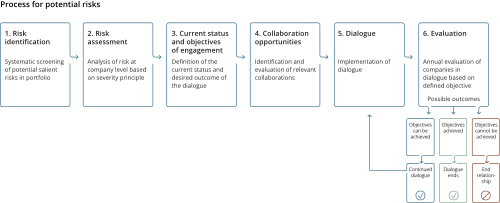
- Risk identification: The Fund uses a data-driven model to identify sectors and countries with a high risk of human rights violations, such as child labour or discrimination. The model also identifies combinations where risk may be elevated, for example a particular sector in a particular country. Risk identification is carried out twice a year. The model is updated regularly, enabling all risks to be monitored over time and allowing changes to be identified at an early stage.
- Risk assessment: The results of the risk identification are supplemented and validated through discussions with experts to prioritise the most severe risks. Consideration is given to whether vulnerable groups, such as women, children or minorities, are affected. Sectors or specific companies are identified for further action.
- Risk management: AP2 works to prevent risks through engagement. Depending on the issue, engagement may be carried out directly, through collaboration, such as various investor initiatives, or through the Council on Ethics. Engagement may be directed at individual companies through dialogue with them, or at an entire sector to drive systemic change.
- Monitoring and reporting: Company progress and the outcomes of engagement are evaluated annually against defined milestones. Areas evaluated include commitments, policies, risk management processes, grievance mechanisms, remedy processes and transparency. Depending on the outcome, AP2 may choose to continue or conclude the dialogue, or divest the holding.
AP2 reviews the Fund’s overall level of human rights risk in listed equities twice a year and reports this to the Board. Activities and outcomes from this work are reported in the Fund’s Sustainability Report.
Due diligence for unlisted assets
We place high demands on external managers and monitor risks in unlisted investments.
The process covers private equity, sustainable infrastructure, agriculture, forestry, conventional real estate and unlisted credit. These asset classes represent approximately 30 per cent of the Fund’s total assets under management.
All these asset classes are managed through external managers. The Fund has close and long-standing relationships with its external managers. As a long-term owner, AP2 has the opportunity to influence the operations of portfolio companies from various sustainability perspectives, including human rights.
- Selection of a new manager or new investment: When investing with a new external manager or making a new investment, AP2 conducts due diligence. This includes questions about how the manager addresses human rights. The purpose is to ensure that the manager shares AP2’s values and respects human rights. Through side letters, the manager is expected to comply with the UN Guiding Principles, the UN Global Compact and, for agricultural managers, the PRI Principles for Responsible Investment in Farmland. The manager is also required to report any controversies to AP2 so that the Fund can follow up on them.
- Monitoring of existing managers: Annual follow-up is carried out through questionnaires and dialogue with managers, both to identify any shortcomings and to support improvements in processes. Where necessary, analyses of human rights risks in unlisted assets are carried out, based on sector and geographic exposure. Managers with high risk and insufficient management are prioritised for dialogue. The Fund’s unlisted holdings are also reviewed as part of the high-risk country process described above. In this context, AP2 conducts in-depth dialogue with managers operating in countries from which the Fund has divested, to prevent elevated risk. The results of this work are reported in the Sustainability Report.
How we act in cases of confirmed violations
Incidents involving adverse human rights impacts are managed through the Council on Ethics of the AP Funds. The Council on Ethics’ process covers listed international equities and credits, which represent approximately 40 per cent of the Fund’s total portfolio.
How AP2 manages harm and contributes to remedy
Remedy concerns how people affected by adverse impacts can obtain redress. In this position paper, AP2 describes how the Fund works with this issue and the responsibility it assumes as a long-term investor.